


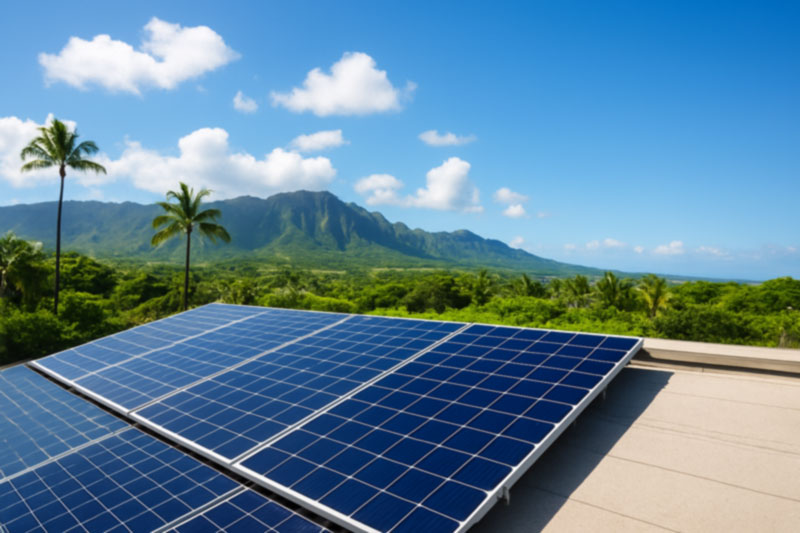
Haru Energy explains that Hawaii homeowners may reduce eligible solar and battery costs through federal and state tax incentives. However, the rules are separate, and eligibility depends on the installation date, equipment, ownership, tax liability, and supporting records.
Key Takeaways: Hawaii solar tax credits can significantly lower project costs, but homeowners should not assume that every 2026 installation receives the same federal benefit. Verify current IRS and Hawaii requirements before signing a contract or filing a tax return.
Overview of Solar Tax Credits
Hawaii solar tax credits are not a single program. A homeowner may need to review a federal clean energy credit, Hawaii’s Renewable Energy Technologies Income Tax Credit, and separate utility or financing incentives.
Federal and Hawaii programs
The federal Residential Clean Energy Credit applies to qualifying solar electric property and residential energy storage equipment. Under Inflation Reduction Act (IRA) rules, the credit is 30% for eligible expenditures. Federal legislation and IRS guidance control the specific tax-year eligibility requirements for residential projects in 2026.
For an installation in 2026, confirm current rules with a qualified tax professional. The contract date, payment date, installation date, and placed-in-service date may have different legal effects.
Hawaii’s Renewable Energy Technologies Income Tax Credit (RETITC) is a state income tax credit for qualifying renewable energy technology. Residential solar electric systems have commonly been associated with 35% of eligible cost, up to $5,000 per system. Annual forms, system limits, and filing instructions control the actual claim.
- Tax credit
A direct reduction of qualifying tax owed, unlike a tax deduction. - Placed in service
The official date equipment is completely installed and ready for use. - Tax liability
The total tax owed that may limit how much of a nonrefundable credit can be used in a single year.
Federal and State Savings Breakdown
Calculate federal and Hawaii incentives separately before reviewing their combined effect. Headline percentages do not guarantee the final amount saved.
For example, a qualifying project costing $20,000 produces a federal credit of $6,000 under the 30% rule. A Hawaii state calculation applies its 35% rate, capped at $5,000 for single-family residential systems. This estimated example illustrates how combined incentives operate together:
| Project Cost Example ($20,000 System) | Incentive Rate / Cap | Estimated Credit Amount |
|---|---|---|
| Federal Clean Energy Credit (ITC) | 30% of eligible cost | $6,000 |
| Hawaii State RETITC | 35% (Capped at $5,000) | $5,000 (Max Cap) |
| Combined Potential Savings | Up to 55% Total Reduction | $11,000 (Net Cost: ~$9,000) |
| Feature | Federal Incentive | Hawaii RETITC |
|---|---|---|
| Authority | U.S. Tax Law & IRS Guidance | Hawaii State Tax Law |
| Typical Focus | Qualifying Solar & Storage Property | Qualifying Renewable Technology |
| Commonly Cited Rate | 30% for eligible expenditures | 35%, subject to residential caps ($5,000) |
| Key Caution | Verify 2026 IRS eligibility | Check current Hawaii tax forms & caps |
Why estimates differ
Project cost may include equipment, labor, permits, electrical work, and other charges. Not every amount necessarily qualifies, and the same cost may be treated differently under federal and state rules. A credit may also be limited by the homeowner’s tax liability unless applicable rules allow a carryforward.
Use dates, itemized invoices, and current tax guidance to support an estimate. Online calculators are planning tools, not final filing decisions.
Does Battery Storage Qualify?
Battery storage may qualify under federal rules, but Hawaii treatment must be reviewed separately. A battery is not automatically eligible merely because it is sold with solar panels.
Storage requirements
Federal rules allow eligible standalone or paired energy storage when it meets capacity, ownership, residential-use, and installation requirements. Under Section 25D, qualifying energy storage systems must have a capacity of 3 kilowatt-hours (3 kWh) or more.
Hawaii may treat generation equipment and storage differently. Request an itemized proposal showing solar equipment, battery equipment, labor, permits, and other work. Do not assume the full battery price qualifies under both programs without checking exact state tax instructions.
Common mistakes to avoid
- Assuming federal and state rules treat batteries identically.
- Using the contract date instead of the official placed-in-service date.
- Claiming tax credits without itemized invoices or proof of payment.
What Steps Protect Your Claim?
A clear timeline and complete records provide the strongest support for a tax-credit claim.
- STEP 1 Confirm the tax year
Record installation, inspection, and placed-in-service dates. - STEP 2 Review equipment
Collect model numbers, capacity data (kWh), warranties, and an itemized cost allocation. - STEP 3 Check current rules
Review IRS guidance and Hawaii Department of Taxation instructions for the filing year. - STEP 4 Keep evidence
Save the contract, itemized invoices, payment records, permits, inspections, and manufacturer spec sheets. - STEP 5 Consult a preparer
Ask a qualified tax professional to confirm eligibility, caps, liability, and required tax forms.
This article is general information, not tax, legal, or financial advice.
How Can Haru Energy Help?
Haru Energy helps homeowners understand project pricing and organize itemized information for tax discussions. A responsible consultation clearly distinguishes estimated incentives from credits confirmed by a tax professional.
Request these proposal details
- Separate itemized costs for solar, battery, labor, permits, and electrical work.
- Expected installation and placed-in-service dates.
- Equipment specifications and warranty documentation.
- Transparent estimates identifying incentives as non-binding projections.
- Organized documents to provide to your CPA or tax preparer.
Electricity costs, roof conditions, backup-power goals, and tax situations vary across Hawaii. Compare net project costs only after confirming which incentives apply to your household.
Hawaii Solar Tax Credit FAQ
Q Are Hawaii solar tax credits available in 2026?
A Yes. Hawaii’s state credit (RETITC) is available under current state tax rules, while federal eligibility (30% ITC) applies to qualifying solar and battery installations in 2026. Confirm both programs for your project’s specific tax year.
Q Can a home battery qualify for tax credits?
A Yes. Under federal rules, energy storage systems with 3 kWh or more of capacity can qualify for the 30% Federal tax credit whether installed with solar or standalone. State eligibility should be verified with an itemized quote.
Q What records should I keep for my tax filing?
A Keep the signed contract, itemized invoices, proof of payment, battery/panel spec sheets, city permits, final inspection sign-offs, and the placed-in-service date.
Review Your Solar Estimate
For a transparent discussion of your Hawaii solar or battery project, contact Haru Energy at 808-744-0922 or request a free estimate through our online web form.