


Haru Energy (Contractor License: CT-38331) provides licensed solar repair and maintenance services across Honolulu, Hawaii, helping homes and businesses protect system performance and service life.
When a solar system produces less power, electricity costs may rise without an obvious explanation. This guide outlines common warning signs, Honolulu-specific risks, and what to expect from a qualified Honolulu solar repair service.
Key Takeaways: Professional solar repair is important in Honolulu because salt air, heat, humidity, and storms can damage panels, wiring, mounting hardware, and inverters. Early inspection helps locate the real cause of reduced output and supports safer, more durable repairs.
Common Repair Warning Signs
A continuing change in solar production is often the first sign that professional inspection is needed.
Lower Energy Production
Compare current production with the same season in previous years. Weather and shading can cause temporary changes, but a sustained drop of 10% to 20% may indicate a failed panel, damaged connection, dirt buildup, or inverter problem.
- Daily production stays below its normal pattern for several days.
- The monitoring app shows missing data or repeated system alerts.
- A panel section looks darker, discolored, or visibly cracked.
- Electricity bills rise despite similar household energy use.
- The inverter shows a red light, error code, or shuts down completely.
Physical and Electrical Problems
An inverter converts the panels’ direct-current (DC) electricity into alternating-current (AC) power for your home. System error codes should not be ignored or repeatedly reset without a professional diagnosis.
Cracked glass, loose conduit, exposed wiring, corrosion, water marks, or unusual buzzing also require immediate attention. Do not touch exposed wires or open electrical junction boxes. Solar panels generate live electricity whenever light reaches them, even during a utility power outage.
Why Honolulu Expertise Matters
Honolulu solar systems face unique coastal conditions that accelerate wear on outdoor electrical and structural components.
Salt Air and Humidity
Salt mist can rapidly corrode panel frames, mounting fasteners, wire connectors, and rooftop junction boxes. Humidity may also cause moisture intrusion as seals and cable glands age, increasing electrical resistance and risk of shorts.
Heat and Intense Sunlight
High rooftop temperatures stress inverters, solar microinverters, and cable insulation. A system may look completely normal from the ground while a hidden electrical connection is deteriorating under thermal stress. Local technicians evaluate coastal exposure, roof temperature, airflow, and equipment age during testing.
| Inspection Focus | What It Can Reveal | Why It Matters |
|---|---|---|
| Panels & Modules | Cracks, micro-fractures, hotspots, soiling | Explains uneven output & prevents fire hazards |
| Inverter System | Fault codes, grid disconnects, overheating | Identifies conversion & power export issues |
| Wiring & Junctions | Loose, burnt, or salt-corroded connectors | Supports safe operation & prevents arc faults |
| Rooftop Hardware | Rust, loose racking, compromised roof seals | Protects the array stability & roof integrity |
A qualified provider assesses the complete system rather than swapping out parts by trial and error. Professional testing distinguishes equipment failure from shading, utility interruptions, monitoring errors, or changed household consumption.
What Does Solar Repair Include?
A complete Honolulu solar repair service combines diagnosis, safe correction, and preventative maintenance advice.
Inspection and Diagnosis
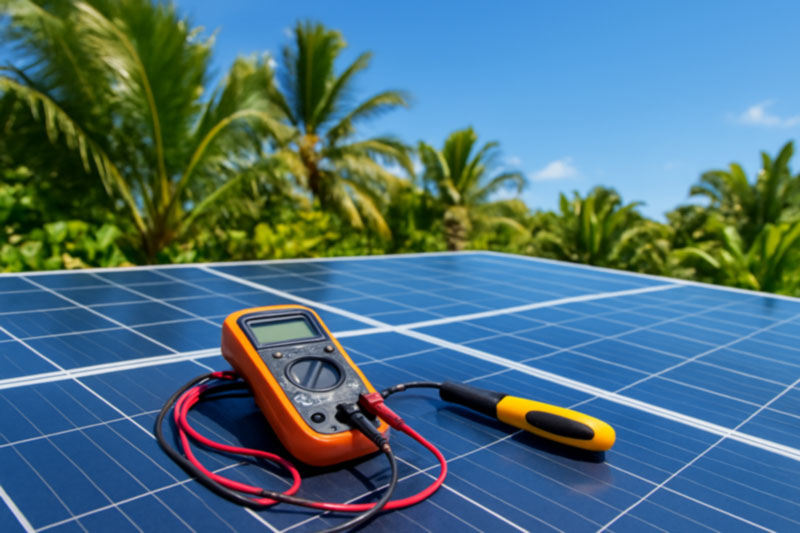
Technicians review system history and monitoring data, inspect visible components, and perform electrical testing (VOC, Isc, insulation resistance). Examining production trends by date helps pinpoint exact failure points.
Typical Repair Areas
- Panel and solar module performance issues
- Inverter fault troubleshooting and replacement
- Corroded connectors, wiring, or conduit repairs
- Monitoring gateway communication problems
- Loose mounting components or roof penetration resealing
- Storm, water intrusion, heat, and salt-mist damage
How the Repair Process Works
- STEP 1 Review symptoms
Share recent utility bills, monitoring alerts, photos, or error codes with our team. - STEP 2 On-site inspection
A licensed technician checks solar generation, electrical connections, and safety conditions. - STEP 3 Transparent evaluation
You receive a detailed report explaining the cause, repair options, scope, and estimated costs. - STEP 4 Repair & verification
The system is repaired and re-tested to confirm full energy production and monitoring connectivity.
Preventative maintenance includes checking hardware tension, inverter performance, seals, and early corrosion—not just washing panels. A professional inspection every 12 to 24 months is recommended, with more frequent checks for oceanfront properties.
How Can Efficiency Be Restored?
Efficiency improves when the underlying electrical fault is corrected, safe operation is confirmed, and root causes are addressed.
Repair Versus Replacement
Repair is best suited for isolated connector damage, bad wiring, monitoring glitches, or individual component failures. Replacement becomes more practical for inverters with repeated circuit failures, severely degraded panels, or outdated equipment near the end of its lifespan.
Decisions depend on measured performance, remaining manufacturer warranty, parts availability, roof condition, and energy goals. A professional technician clearly separates urgent safety repairs from optional upgrades.
Value of Professional Repair Service
- Safer troubleshooting
Licensed testing eliminates contact risks with high-voltage DC equipment. - Accurate diagnostics
System-wide testing prevents unnecessary equipment replacement costs. - Extended service life
Early intervention stops salt corrosion before it ruins entire sub-arrays. - Warranty assistance
Documentation supports manufacturer warranty claims and insurance records.
Low production is a symptom, not a diagnosis. Evidence-based testing helps Hawaii homeowners avoid guesswork and make informed repair decisions.
Solar Repair FAQ
Q How quickly should low production be checked?
A Arrange an inspection when a drop in production lasts several days, the inverter displays an error code, or output differs substantially from historical trends. Exposed wiring, burning smells, or water leaks require prompt professional attention.
Q Can salt air damage solar panels and inverters in Honolulu?
A Yes. Salt air accelerates corrosion on metal frames, roof mounts, wire connectors, and inverter housings. Coastal systems benefit from periodic professional inspections even when panels appear normal.
Q Are solar repair costs covered under manufacturer warranties?
A In many cases, yes. Most major panel manufacturers offer 25-year performance warranties, while inverters typically carry 10 to 25-year warranties. Haru Energy can evaluate your system and help submit warranty documentation to manufacturers.
Schedule Your Honolulu Solar Diagnostic
For reduced energy output, inverter fault codes, or salt air corrosion concerns, contact licensed Honolulu contractor Haru Energy (License: CT-38331) at 808-744-0922 or request a diagnostic review online.