


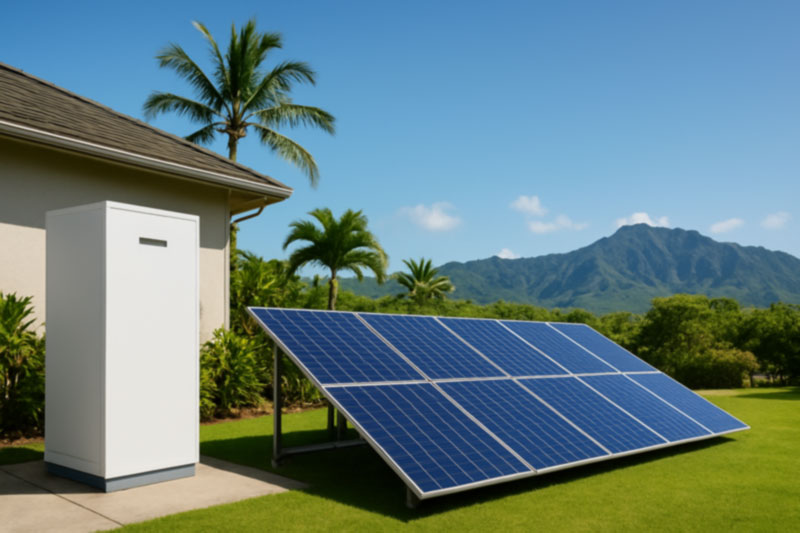
In Hawaii, adding a battery storage system to an existing solar setup commonly costs $10,000–$20,000 before incentives, while a complete new solar plus battery system typically ranges from $25,000 to $40,000+. Capacity, backup goals, electrical upgrades, permitting, and site conditions determine the final price. Because Hawaii has high electricity rates, storage may also reduce expensive evening power purchases.
Summary: A Hawaii battery system requires a substantial upfront investment, but solar self-consumption, outage protection, and highly favorable Hawaii solar incentives (such as the 30% Federal ITC and up to $5,000 State RETITC) can drastically improve its value. A site-specific load analysis is more reliable than a standard package price.
Average Solar & Battery Costs in Hawaii
A typical residential battery installation (add-on) costs about $10,000–$20,000 before incentives. If you are installing a brand new solar panel system paired with a battery, the total project generally ranges from $25,000 to over $40,000. Larger systems, whole-home backup, multiple batteries, or service-panel work may raise the project cost further.
What the price usually includes
A quote may cover the battery, inverter, transfer equipment, permits, labor, monitoring, and commissioning. Ask whether taxes, structural work, utility fees, panel upgrades, and future service are included.
| System Size | Usable Capacity | Typical use | Indicative installed range (Battery Only) |
|---|---|---|---|
| Small system | 5 – 10 kWh | Essential loads and short outages | $10,000–$14,000 |
| Mid-size system | 13.5 kWh (e.g., Tesla Powerwall) | Evening solar use and selected backup | $14,000–$20,000 |
| Larger system | 20+ kWh (Multiple units) | Extended backup or whole-home support | $20,000–$35,000+ |
These are planning ranges, not guaranteed quotes. Labor and permitting can vary between Oahu, Maui, and other islands. Commercial projects may need larger switchgear, controls, or engineering review.
What Affects Solar Battery Prices?
The main cost drivers are usable capacity, power output, backup coverage, electrical modifications, and installation complexity. The advertised battery price does not always include these items.
Capacity and power output
Usable capacity, measured in kilowatt-hours (kWh), indicates how much energy the battery can supply. Power output, measured in kilowatts (kW), determines which appliances can run together. Air conditioning, pumps, refrigeration, and medical equipment may require higher output.
- Usable capacity for overnight consumption
- Continuous and surge power capabilities
- Number of batteries and expansion options
- Critical-load panel vs. whole-home backup setup
- Wiring, permits, inspection, and interconnection requirements
Home, business, and island conditions
Brands such as Tesla Powerwall and FranklinWH differ in capacity, software, warranty, and installation requirements. Coastal properties in Oahu may require specific salt-air resistant installations. The best choice is the system that matches the property’s load profile and outage priorities.
How Do Hawaii Rates Improve Battery ROI?
High Hawaii electricity rates can strengthen the case for storing daytime solar and using it during evening hours. ROI, or return on investment, compares the system’s financial benefits with its initial cost.
Self-consumption and time shifting
Solar self-consumption means using solar power on-site instead of exporting it. A battery stores excess midday production and discharges after sunset, potentially reducing utility purchases when household demand is highest.
Value beyond payback
- Backup power during grid interruptions and hurricanes
- Greater use of on-site solar generation
- Less exposure to changing HECO electricity prices
- Support for critical business operations
The best battery is sized for the hours and loads that matter most, not simply for maximum capacity.
Which Hawaii Solar Incentives Reduce Cost?
Hawaii solar incentives can significantly reduce the effective net cost of your system by combining federal and state tax credits. As of 2026, homeowners can take advantage of several lucrative programs.
Key Incentives to Claim
- Federal Investment Tax Credit (ITC): Provides a massive 30% tax credit on the total cost of solar and standalone battery storage installations.
- Hawaii State Tax Credit (RETITC): Offers an additional 35% state tax credit, capped at $5,000 per residential system.
- HECO Smart Programs: Hawaiian Electric’s Smart Renewable Energy (SRE) and Bring Your Own Device (BYOD) programs offer upfront cash or monthly bill credits for sharing stored battery power with the grid.
- Property Tax Exemptions: Many local jurisdictions, including Honolulu County, offer property tax exemptions for the added home value of solar installations.
Do not treat an incentive as guaranteed savings until an official source or qualified tax professional confirms your eligibility. Request a quote that separates gross price, estimated incentives, financing charges, and net cost.
Is Battery Storage Worth It?
Battery storage is highly worth evaluating when a property has high evening consumption, outage concerns, or unused solar generation.
A practical decision process
- STEP 1 Review usage
Examine 12 months of bills and identify evening peaks, critical appliances, and seasonal changes. - STEP 2 Define backup
Choose essential-load (e.g., 10kWh) or whole-home coverage (e.g., 20+ kWh) before selecting capacity. - STEP 3 Check incentives
Verify the 30% Federal ITC, $5,000 State RETITC, and HECO rules to document the expected net cost. - STEP 4 Compare scenarios
Request savings, runtime, warranty, and replacement assumptions in writing.
Important limitations
- A battery does not eliminate all utility fees (minimum grid connection fees still apply)
- Long outages may require load management
- Usable capacity naturally declines over the 10+ year lifespan
For Oahu, Honolulu, and Maui owners, a trustworthy proposal should explain benefits and limitations. Haru Energy can prepare a custom estimate based on energy use, solar production, backup loads, and available Hawaii solar incentives.
Battery Storage FAQ
Q How much does a solar battery cost in Hawaii?
A Adding a battery to an existing system typically costs $10,000–$20,000 before incentives. A completely new solar plus battery installation ranges from $25,000 to $40,000+. Capacity, backup scope, and electrical work affect the final quote.
Q Are Hawaii solar incentives available for batteries?
A Yes. In 2026, qualifying battery systems are eligible for the 30% Federal ITC and the 35% (up to $5,000) Hawaii State Tax Credit (RETITC), along with HECO programs like BYOD. Confirm details with a tax professional.
Q How long will a 13.5 kWh battery power my house?
A Runtime depends on connected loads. A single 13.5 kWh battery can power essential loads (fridge, lights, Wi-Fi) for 12 to 24 hours, but running heavy appliances like A/C will deplete it in just a few hours.
Q What should a battery quote include?
A Request equipment specs, usable capacity (kWh), labor, permits, upgrades, warranty, monitoring, estimated tax incentives, and net out-of-pocket price in writing.
Request a Trusted Energy Review
Haru Energy provides a free energy-needs assessment and custom estimate for Oahu homes and businesses. Review your usage, backup priorities, and incentive assumptions before deciding.